TikTok Became Gen Z’s Search Engine: The Visual Revolution Killing Traditional Search
40% of Gen Z uses TikTok for search. Learn why visual experiences beat traditional results and how brands can adapt. Master the new search landscape now.
The Unspoken Shift in Digital Behavior
A 19-year-old in Dubai craves ramen. Instead of Googling "best ramen near me," she opens TikTok, types the query, and scrolls through videos of steaming bowls, crowded tables, and diners’ reactions. She bookmarks three spots, all in under 60 seconds. Google never enters the equation. This ritual repeats millions of times daily. 40% of Gen Z now prefers TikTok over traditional search engines for discovery, turning the app into a visual command center for everything from travel hacks to career advice. The implications are tectonic: Search is no longer about links, it’s about lived experiences.
Why Gen Z Abandoned Google
Google’s results feel sterile to a generation raised on visual storytelling. Endless blue links, SEO-stuffed articles, and ads dominate its interface. TikTok, by contrast, delivers raw authenticity: real people, immediate visuals, and unfiltered opinions. Trust lies with peers, not algorithms.
- The "Echo Chamber" Advantage: TikTok’s algorithm learns preferences faster than Google’s history-based profiling. A search for "flat tire help" surfaces videos shot in rain, at night, or with minimal tools, anticipating unspoken context.
- Speed Over Depth: 62% of Gen Z finds TikTok’s sub-60-second videos more efficient than reading blog posts (ironic). As one user told Euronews, "I don’t want to find answers, I want to experience them".
- Trust in Tribes: 86% of Gen Z distrusts AI-generated content, favoring creator-led tutorials where comments like "THIS WORKED!" act as credibility badges.
Google knows it’s losing. Its SVP admitted nearly 40% of young people use TikTok or Instagram for restaurant searches.
The Mechanics of TikTok’s Search Dominance
TikTok engineered its rise through four pillars traditional engines can’t replicate:
- Spatial Context Processing
- While Google parses keywords, TikTok’s AI interprets environments. A search for "small apartment workout" surfaces videos filmed in cramped bedrooms using chairs as weights. Geolocation data combined with visual cues (e.g., street signs in videos) enables hyperlocal results Google Maps can’t match.
- Temporal Answer Compression
- TikTok enforces solution-first delivery. Successful videos solve the query within 3 seconds, no introductions. A plumbing company’s viral clip starts with a wrench unclogging a drain as text overlay states: "Stopped your sink in 10 sec." Videos retaining 92%+ viewers rank highest.
- Cross-Modal Trust Signals: TikTok’s search weighs unconventional engagement:
- Rewatch clusters (users replaying 0:17 of a dance tutorial)
- Digital body language (screenshots/saves signal "reference value")
- Comment threading ("Would this work on laminate?" debates)
- The Commerce Engine
- 77% of Gen Z discovers products on TikTok, often via hashtags like #TikTokMadeMeBuyIt. When Target posts "3 p.m. couch corner open + half-priced Murakami," foot traffic spikes 23%. Google can’t replicate this real-time ephemeral marketing.
The Human Toll: Google’s Identity Crisis
Google’s struggle isn’t technological, it’s cultural. Its tools remain powerful for complex queries (e.g., tax laws), but Gen Z uses them 25% less than Gen X for daily discovery. Three fractures define the gap:
- The Personalization Paradox: 88% of Gen Z shares data willingly for better TikTok recommendations but distrusts Google’s tracking.
- Information Overload vs. Instant Gratification: Google serves 1,000+ results for "Python loop error"; TikTok shows one 15-second fix.
- The "Link Graveyard" Effect: 45% of Gen Z actively avoids sites that feel AI-generated. As one Redditor noted: "Google feels like a library catalog. TikTok feels like a friend" 28.
Brands Winning the TikTok Search Game
Sephora bypassed Google entirely for Gen Z. Its strategy:
- Mine beauty questions from Reddit (e.g., "How to cover rosacea without cakey makeup?")
- Create 25-second TikTok tutorials using employee-generated content
- Repost customer results with #SephoraSolutions
Result: 200% higher conversion from TikTok search vs. Google Shopping ads.
Other Tactics in Play:
- Duolingo’s Snackable Answers: "Spanish subjunctive in 20 sec" videos target high-intent queries, using text overlays with keywords.
- Local Bakery Geo-Tagging: "Croissants ready in 15 mins" posts with location tags attract nearby searchers. TikTok’s SIM-based geotargeting beats Google’s IP tracking.
- Patagonia’s Evergreen Utility: Videos like "How to repair a zipper" stay discoverable for years, algorithmically favored for solving permanent problems.
The Dark Side: Misinformation and Fragmentation
TikTok’s search has critical flaws:
- Its algorithm prioritizes engagement over accuracy, risking viral "health hacks" without scientific backing.
- Personalization tightens echo chambers. Searches for "climate change" show only confirming viewpoints.
- Platform fragmentation forces multi-tool searches: TikTok for experiences, Reddit for reviews, Google for verification.
The Future: A Fragmented Search Ecosystem
Google won’t die; it will specialize. By 2027, search will splinter into intent-based lanes:
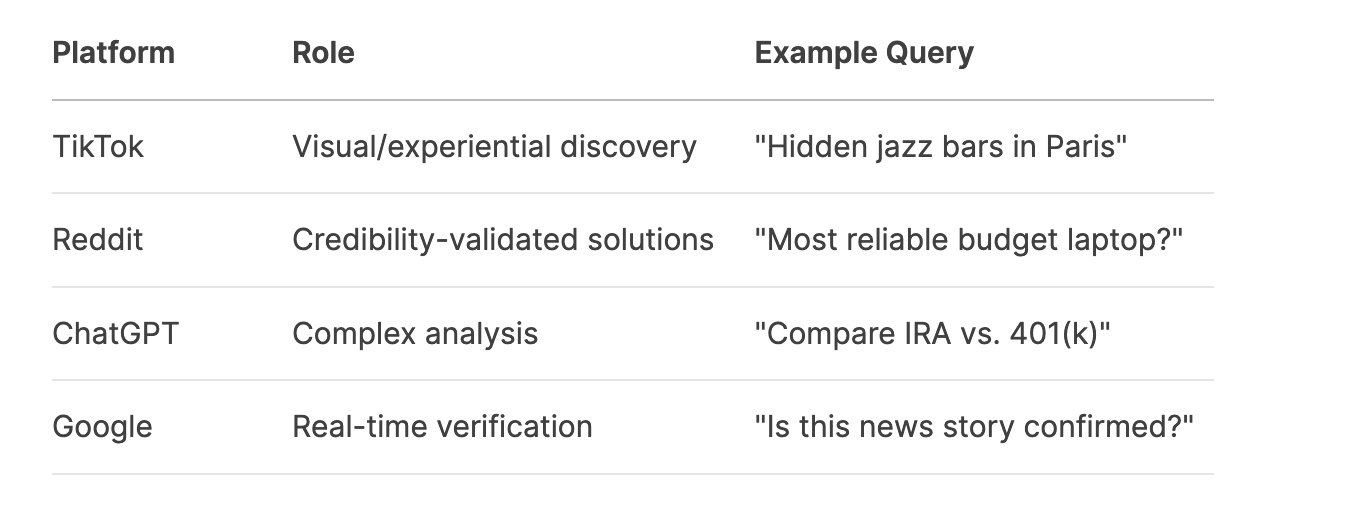
For brands, this demands a "search everywhere" strategy:
- Repurpose TikTok videos for Pinterest’s inspiration engine
- Convert top Reddit AMAs into YouTube Shorts
- Optimize FAQ pages for ChatGPT’s web scraping
Conclusion: The Post-Link Search Era
TikTok didn’t kill Google, it redefined what "search" means. Gen Z demands answers that show rather than tell, prioritize community validation over domain authority, and respect their shrinking attention spans. As Chris Loschiavo of Google conceded: "Young people expect systems to be fast, visual, and deeply responsive to context" 8. Brands clinging to keyword density and backlinks will fade. Winners will engineer empathy-driven content machines that solve real problems in 60 seconds or less, no blue links required.
The bottom line: If your content isn’t designed to be screen-recorded, bookmarked, or rewatched at 0:17, it’s already obsolete.